

It sounds cliché, but in sign making, your inkjet printer is a lot like your best employee. Every banner, window graphic, vehicle wrap, trade show display, and retail poster that leaves your shop passes through it. You need a printer you can rely on, and one that's specifically designed to help your shop look its best. The speed, quality, color accuracy, substrate compatibility, and durability of your printer's output define your reputation and sustain a successful business.
In today's fiercely competitive sign industry, clients expect faster turnaround, wider color gamuts, and substrates that perform in conditions ranging from blazing outdoor sun to temperature-controlled retail interiors. Your printer determines which clients you can serve, which jobs you can take, and ultimately, how profitable each square foot of output really is.
Here we'll explore a few questions designed to provide you with basic information on wide-format digital inkjet printers, including the different types of printers, how much space you'll need to allot, and what you can expect in terms of ink and maintenance costs, and some thoughts on pricing your output.
What is a large-format or wide-format digital printer?
A large-format or wide-format inkjet digital printer is a specialized, computer-controlled printing machine designed to produce high-quality, large-scale graphics exceeding standard printing sizes (generally over 18 inches long, and up to 100+ inches wide).
Synonyms for these devices include plotters, and, for the largest printers, grand or super-wide format printers. Wide-format digital printers are versatile devices, often used to produce banners, posters, decals, vehicle wraps, interior and exterior signage, along with window, wall and floor graphics.
Wide-format digital inkjet printers are categorized by ink type: Broadly, there are eco-solvent, UV, and latex ink printers. Each of these ink types is designed for different applications.
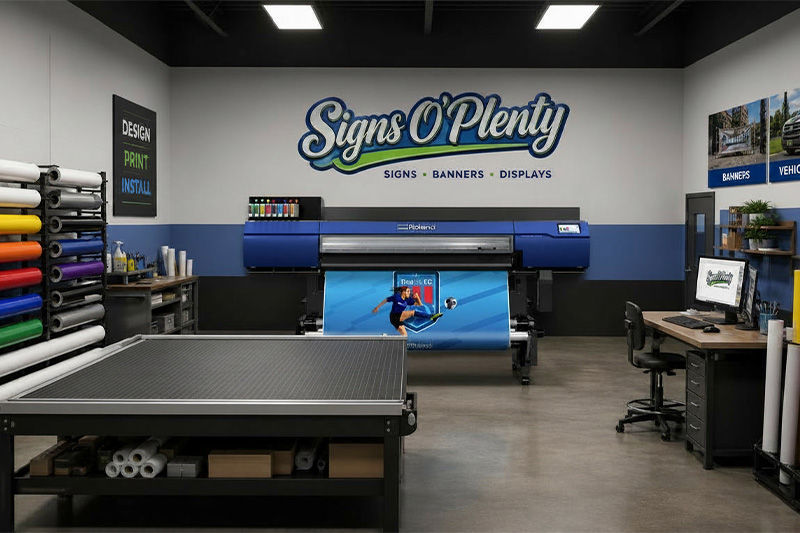
How much space do I need for a wide-format printer?
Wide-format printers come in several sizes, determined by the width of their printable area. For example, a 54-inch wide-format printer can print on media rolls that are 54 inches wide.
For a 30-inch printer or printer cutter, you will need a space measuring 2' x 5'. For a 54-inch or 64-inch wide-format printer or printer/cutter, allot a space measuring 3' x 10'.
The amount of space needed is due to the size of the machine itself, of course, but also the extra space required to maneuver large rolls of media and carefully remove the output.
The space where your printer is located should also be a clean, low-dust temperature and humidity-controlled area. You ideally want a room where you can design, print, cut, and laminate without dust, debris or humidity affecting your results.
How much does ink cost per print?
When comparing ink costs, it's important to remember that manufacturer-produced inks are designed to run optimally with your print device and are specially formulated to produce the highest quality output. Also, using any other inks may void your warranty.
Typically, the cost per print is calculated in square feet printed. Although the costs vary considerably by manufacturer and ink type, average estimates place the ink costs ranging as low as $0.12 per square foot to as high as over $0.32 per square foot printed. Keep in mind that specialty colors like white or varnish inks can add to the average cost per print as well.
What are average maintenance costs for a wide-format printer?
Wide-format digital printer maintenance costs vary widely based on usage and ink technology, ranging anywhere from a few hundred to a few thousand dollars annually. The key expenses you're likely to encounter include extended service agreements, end-user replacement consumable parts, and any out-of-warranty repair costs associated with having a technician onsite.
In considering different printers and ink technology, review the original manufacturer's warranty that may be included with their devices, as well as what exactly is covered within the warranty parameters, such as parts, labor, and travel. Extended service contracts and keeping your device under the manufacturer warranty can also remove some of the risk of unexpected costly repairs and provide peace of mind.
How much should I charge for a print?
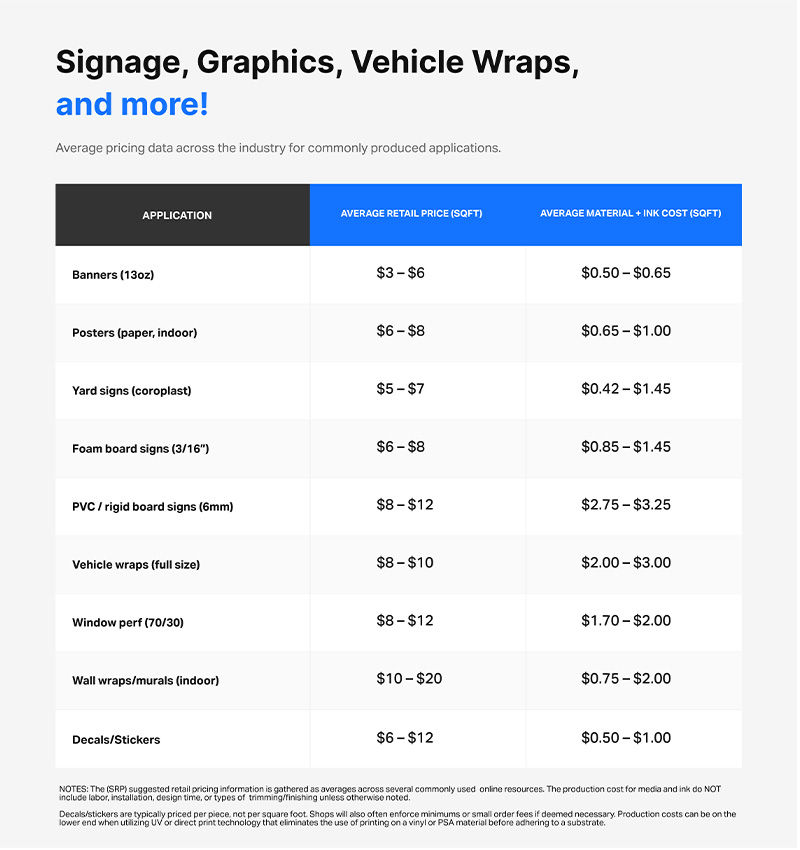
A rough rule of thumb is that for commodity prints, the costs are driven by materials. For specialty graphics, costs are driven by the amount of labor involved.
Below are some general guidelines for material and ink costs for different applications, as well as average retail prices for those products, in 2026.
How long does a set of inks last?
We get this question a lot, and while it's hard to provide exact numbers, we've estimated that for the TrueVis XP-640 64-inch eco-solvent printer, based on average ink consumption, a set of inks would be able to print 8-9 rolls of 54" wide material.
Is there any software I need?
You will need a Raster Image Processing (RIP) software to process and send your graphics to your printer. Roland DG wide format inkjet printers come bundled with Roland DG VersaWorks, a feature-packed, powerful RIP included at no charge. This is a substantial advantage and cost savings as RIP software packages can cost upwards of $4,000.
In addition, purchasing a Roland DG printer provides you with access to the Roland DG Connect application, which includes a design software package that lets you quickly and easily set up artwork, create templates and jig layouts with intuitive tools and built-in resources like typefaces, shapes, and images.
How easy is it to learn to operate a wide-format printer?
The answer varies by manufacturer, but Roland DG printers are known for their ease of use, even for operators who are new to wide-format printing. The interface is intuitive, and key processes—like loading media, setting up jobs, and performing routine maintenance—are guided step by step.
Most users can get up and running with basic printing and cutting the same day, and with a bit of practice, they're operating confidently within a few days. For more advanced applications, Roland DG provides training resources and support to help users continue building their skills.
What other factors should I consider in choosing a printer for my sign shop?
In addition to the information above, it's important to know which applications you'll be running most frequently, to ensure you select a device with the best ink type for your shop's production. Here is a page where you can enter the types of products your sign shop provides, such as vehicle graphics, signage, or stickers, and it will recommend appropriate printer options.
Another factor to consider is the volume of print you anticipate needing in the next year or so. Here is a blog that describes some of the considerations when choosing your printer size and production capabilities.
Conclusion - What is the best printer?
The best printer for your shop comes down to the size of your shop, the types of projects you are outputting, the volume of your production and your overall budget when considering operating costs and maintenance. These factors will help determine what printer is best for your shop. If you need more help narrowing things down, try the Roland DG online printer selection tool.
Have more questions?
Reach out to a Roland DG expert today.
