Expanding Horizons with Roland DG Technology
Ball High School Tor Store Projects | Galveston, Texas


Ball High's Tor Store Projects includes a store with products customized or created on site that is run by two teachers and their business and special education students.
An essential part of the growth of our program was due to that investment into Roland DG equipment. It really enabled us to carry out our vision for the Tor Store.
Before
- The teachers wanted to be able to offer additional products produced by students.
- The teachers wanted to expand the number of students participating in the Tor Store Projects.
After
- With expanded product offerings, the Tor Store has gone from being open one hour a day to being open all day.
- The number of students participating in the program has grown from 10-20 to 50-65.
- The proceeds from the Tor Store are now helping to fund additional projects including a raised bed garden at the school.
Ball High School in the coastal town of Galveston, Texas, is the oldest high school in the state and is known by its tornado mascot. Like many high schools, it has a school spirit store. But the “Tor Store” is unlike any other school store you’ll find. It has been undergoing big changes since two instructors took the reins and brought in the power of digital production, revamping its product line and empowering students to create a revenue-driven sustainable business within the school.
Ball High’s Tor Store is run by Stephen “Rob” Lewis and Darren Muren, two seasoned instructors that have brought together students from business and special education classes to create a self-sustaining and student-led initiative. Lewis and Muren wrote grants to fund digital production equipment that allows their students to customize spirit wear and merchandise in-house, as well as offer sign and graphics products.
We talked with Lewis and Muren about their decision to revamp the store, how they selected their production equipment, and how their store’s operation reinforces their motto, “everyone is essential.”
How did you two decide to expand the Tor Store?
Rob Lewis: I teach entrepreneurship and incubator classes, and Darren teaches work-based learning and Special Education courses. Both of us also formerly coached for the school. We just had this idea: How can we change the paradigm and create something that meets the needs every student of every ability level?
Darren Muren: When I took over the Tor Store in 2017, it had a Cricut and a coffee maker, and the store was open one hour a day. Later, we were able to have the store open four class periods a day, and next year, it will be open all day. We are also expanding to include work-based learning kids.
After Rob and I began implementing our ideas, we became co-founders and co-executive directors of Tor Store Projects. Tor Store Projects now includes a retail store with apparel and merchandise, along with a fabrication space and sign shop, and a few other, related initiatives. What we’ve created with the Tor Store is a revenue-driven, sustainable business within the school.
How do business and Special Education students work together with instructors to run the Tor Store?
Lewis: There is a special unity between Special Education and Business students. Our guiding principles are authenticity, employability, inclusivity, and sustainability. We aim to maximize the potential of all students and give them skills for lifelong prosperity. Business students are managers and team leads, and our differently abled students act as valued team members with some achieving management positions on the retail front.
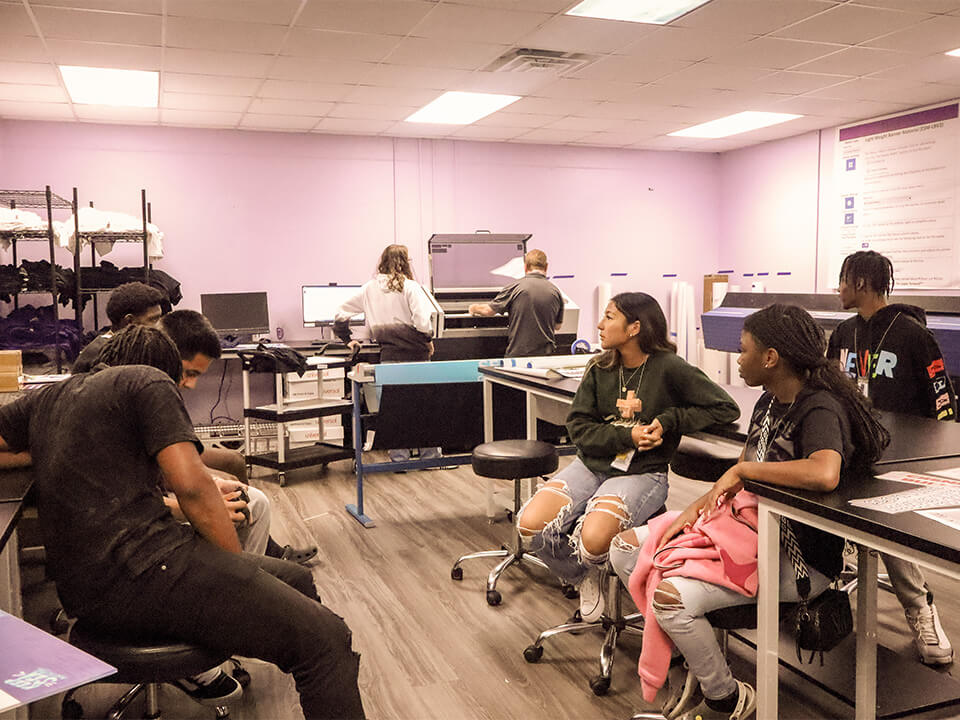
Initially, we had 10-20 kids in the program for 45 minutes. Today we’re working with 60-75 kids over the entire school day. We work with all special education students in some capacity, including life skills students.
How did you equip the store?
Muren: We had the idea of writing a grant. Being from Galveston, I knew about the Moody Family Foundation. We applied there for a $350,000 grant, and we won it. Then we applied for several more grants that were also successful. With those resources secured to purchase equipment, the next step was to find the right technology for our purposes.
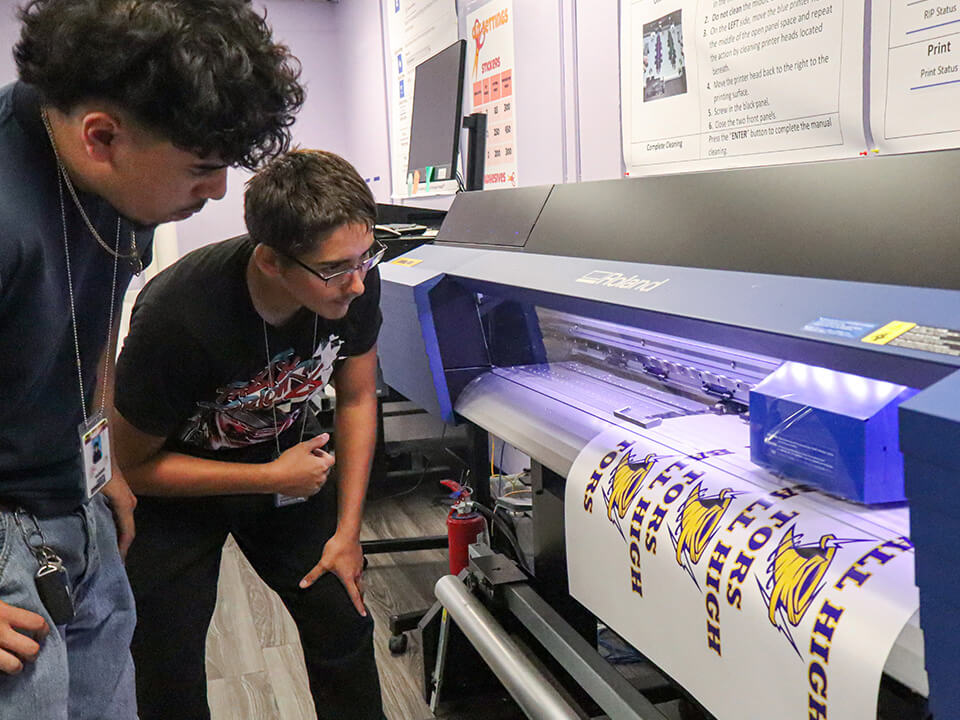
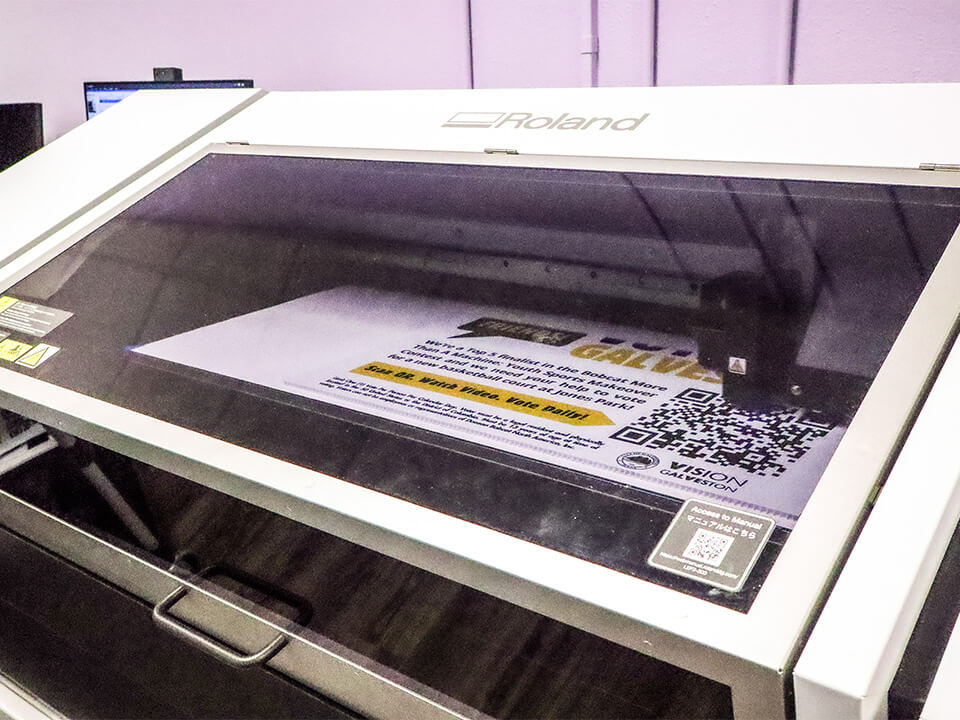
We’d met Brian Allen and later, Ian Allen, at Lab Resources who did a lot of work with our CTE classes. We asked him to show us all of their machines. After carefully considering our options, we decided to purchase two Roland DG TrueVis 54-inch eco-solvent printer/cutters – an SG2-540 and a VG2-540 – plus a Roland DG LEF2-300D UV benchtop flatbed printer. We also got a laminator and a few other pieces of equipment. From there, our efforts to develop the Tor Store really grew organically.
Lewis: An essential part of the growth of our program was due to that investment into Roland DG equipment. It really enabled us to carry out our vision for the Tor Store.
What are you producing for your store?
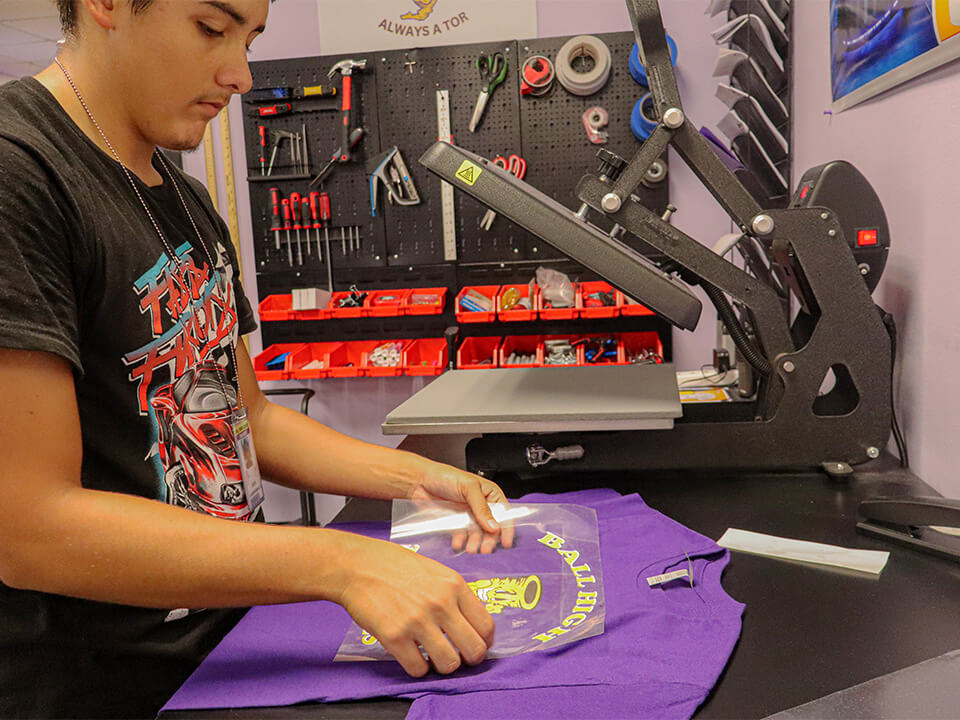
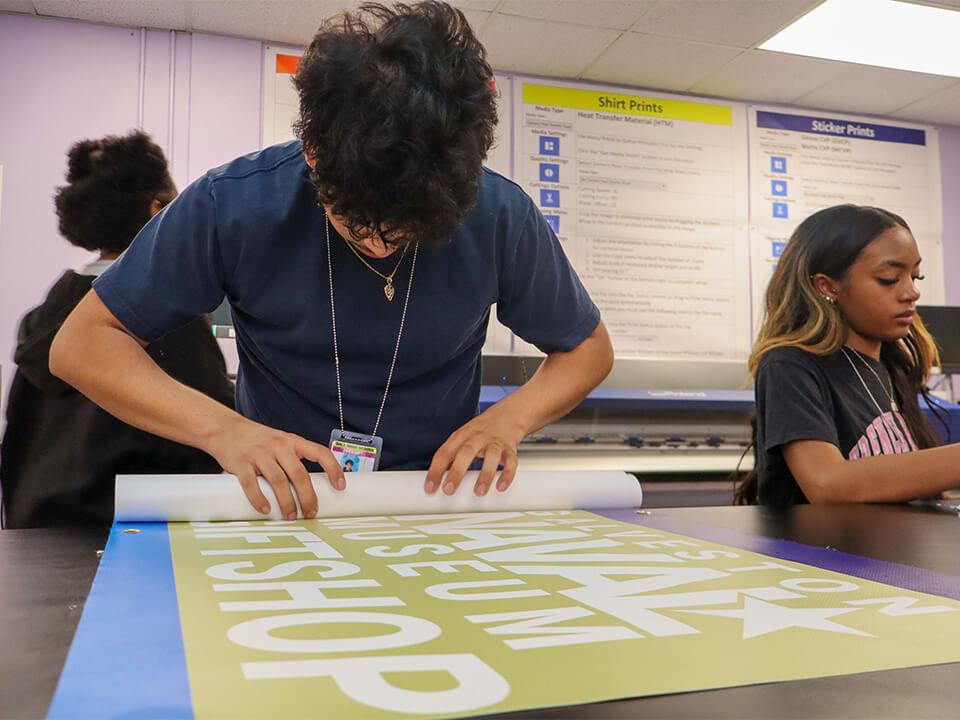
Lewis: We print HTV on our printer/cutters and run four heat presses to produce T-shirts, sweatshirts, hoodies, sweaters, and school spirit shirts for the district as well as apparel for the high school. We provide T-shirts for community partnership efforts like a beach cleanup and other work by groups like the Turtle Conservancy at Galveston College.
We also produce a lot of banners, posters, photography, and stickers on our printer/cutters. We use our UV flatbed printer to print directly on cups, golf balls, jewelry, and Mardi Gras bead medallions, as well as to create signage.
As far as products go, we’re only limited by our own learning – there are so many products we can produce or customize on these versatile printers!
Muren: After walking into the Tor Store, people have a look of childlike wonderment on their faces. The store has so many cool products, all produced by students. People are galvanized and astonished by what can be done.
How does the production work?
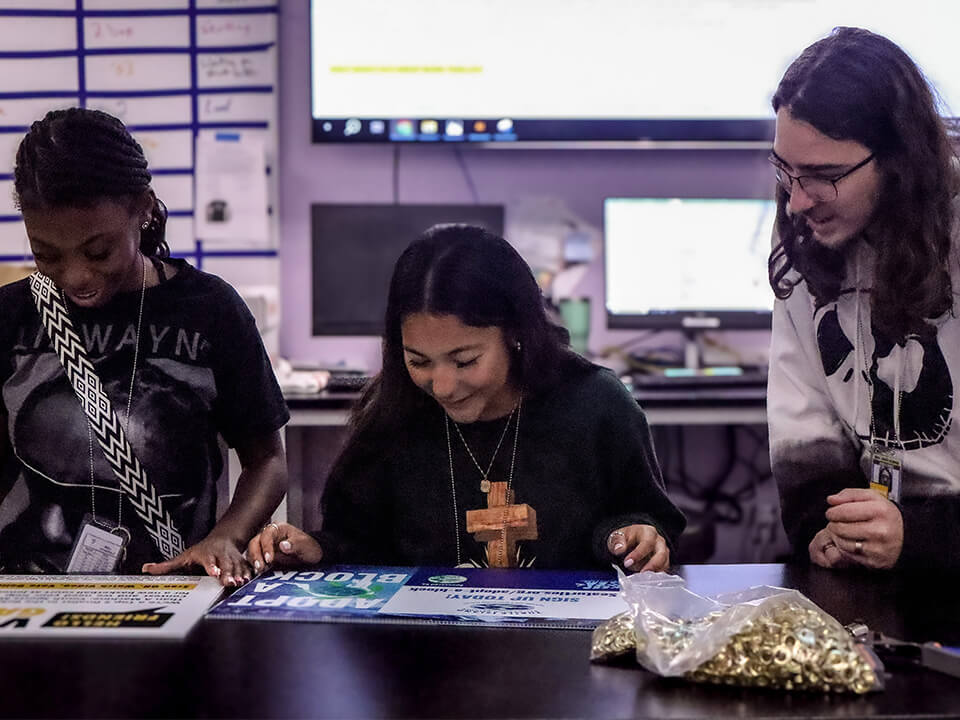
Lewis: It’s a totally collaborative process. Our students handle everything from concept to fulfillment. They do 90% of design work. They also run the machines and maintain them.
We teach our students every aspect of running the organization so they acquire skills that will help them acquire future employment.
What other projects does Tor Store Projects have going?
Lewis: Galveston hosts the second largest Mardi Gras in the U.S outside of New Orleans and every year more than 3 million beads are thrown. We were approached by Mike Dean, the owner of Galveston Mardi Gras, who suggested that we start a Mardi Gras bead recycling program, replicating Arc-GNO from New Orleans, and so began, “Beads for Needs.” Now, we recycle over 300,000 beads that are donated annually. Our students collect, classify, sort, and repackage the beads for sale online or in the Tor Store.
Tor Store Projects also partners with other nonprofits, for example our local farmers’ market. We now have a raised bed garden where we grow food and local businessmen, such as Dennis Byrd and others, that allow our students to train for employment.
We also sponsor an annual 5K race called “Everybody’s Essential Fun Run.” All race proceeds go to Special Education students and Special Olympics.
What are some of the outcomes of this collaboration?
Lewis: Tor Store Projects has so far produced about $300,000 in revenue and growing. It’s a self-sustaining project now that can be exported and replicated at other schools.
One of the coolest things to see is how the entrepreneurial kids grow in empathy and patience with the special education kids. Some of the Special Ed students are barely verbal – to see the kids interact removes the veneer and allows them to find the goodness in each other.
The kids really want to be a part of the Tor Store Projects. They want to learn the skills they’ll need to be successful after graduation. In our district, 76% of kids are economically disadvantaged. These skills can help them find good jobs or enhanced opportunities programs when they leave Ball High.
We are also seeing that some of our students are finding jobs. One of my good buddies, Dennis Byrd, who owns a growing hospitality empire, invites our students to come out to work at his restaurants and hotels. Bringing the skills from their work at Tor Store Projects, these students can find employment to fit their skills. We’re starting to see major traction.
What do you see for the future of Tor Store Projects?
Lewis: Phase One is validating each project, Phase Two is expanding them, and Phase Three is exporting the projects to other schools. We’d like to start a fabrication and assisted living center here in Galveston, where students can work after they graduate and prosper in a life of independence.
After receiving an additional $200,000 in grant funding, we are now considering multiple Roland DG machines to expand our business venture, including the CO series for large format signs and direct-to-garment (DTG) printers for more custom prints. It is truly an exciting time!